
The Tired That Sleep Won’t Fix
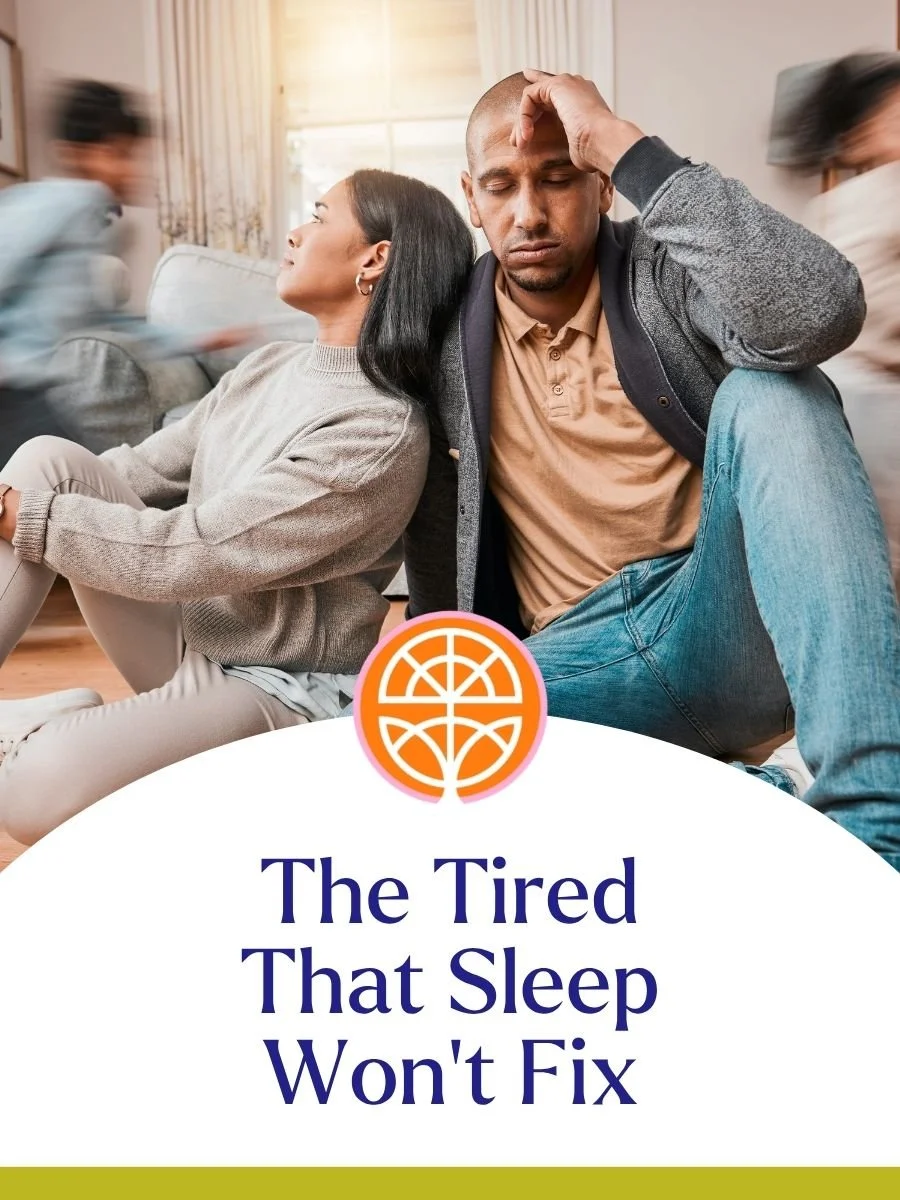
You slept eight hours last night. You had a quiet morning and even took that walk you have been promising yourself. You did the things, and you are still exhausted.
Deep down, you know it’s not the kind of exhaustion that a good night's sleep fixes or the kind that a long weekend solves. It’s something deeper. Something that has been sitting underneath all the doing, managing, showing up, and it is not moving.
If this is you right now, I want you to stop for a moment. Nothing is wrong, I think you have been trying to fix the wrong kind of tired.
Not your ordinary tired
After years of living this international life myself and sitting with hundreds of expat parents who are navigating it too, the tired that most of us are carrying is not just about sleep.
It is more about what we are holding: multiple languages, cultures, identities, and often all before 9am. You are the one who remembers which form needs to go to which school, in which language, by which deadline. You are the one who is building community from scratch, while quietly grieving the community you left behind. You are the one who shows up for your children's identity questions while your own identity questions are still quietly unanswered.
You are doing all of this, often, without your village. Without the grandmother who would take the kids on a Tuesday. Without the friend who has known you since before you became a parent. Without the context that makes you feel like yourself.
That is not a small thing. That is enormous, and it means that when you are tired, it is rarely just one kind of tired. It is usually all three at once.
The Three Kinds of Tired (and Why They Each Need Something Different)
This framework has changed things for me and for the parents I work with.
When you know which kind of tired you are in, the right response becomes clear. You stop pushing through when stillness is what is needed. You stop resting when the moment is actually calling for curiosity and reflection.
Three kinds of tired with three different responses.
Depletion
This is the body tired. Your nervous system is running on empty. The basics have been quietly slipping: sleep, nourishment, water, stillness, as everything and everyone else has needed you first. You have been giving, holding, managing and showing up, and somewhere along the way you stopped receiving.
This is the tired that feels like you cannot think clearly. When your patience is thinner than it should be, and you are going through the motions of your life without really being inside it.
Depletion does not need a strategy. It does not need a new routine or a productivity hack. It needs the simple things, returned to you with intention: rest, real food, water and time outside where you are not looking at your phone.
These things are not glamorous. However, your body is the container for everything else you want to build, and you cannot fill anyone from an empty cup. I know that is a phrase you have heard before, but I mean it very literally. A depleted nervous system is not available for creativity, for connection, for the kind of present parenting you actually want to offer your children. You need to be regulated first, always.
A question to sit with:
Where am I giving more than I am receiving right now?
Where is one place I can receive today, without earning it first?
Integration
This is when the soul tired.
Something has shifted recently. Maybe it was a move, a new baby, new chapter in your career or your partnership? Maybe it was an honest moment with yourself about the gap between the life you envisioned and the one you are actually living? Maybe it was something deeper like grief, loss or a conversation that cracked something open?
Whatever it was, your system is not broken. It is reorganizing.
Integration tired is the tired of becoming. It is what happens when you have touched something new inside yourself, and your whole internal architecture is rearranging itself around that new frequency, while your old pace, patterns, and life are still demanding your presence and attention.
That is exhausting, and the most important thing I can tell you about integration tired is you cannot solve it, push through it or schedule your way out of it. The only thing that works is to slow down and let it complete.
The wisest expat parents I know have learned something that goes against everything our culture tells us to do. They have learned to slow down after a shift and wait. This is not because they have unlimited time, but because they have discovered that you cannot rush what is trying to find its shape inside you.
It’s also important to note that the insight is not the transformation, the integration is. Integration does not happen in the doing. It happens in the pauses between the doing: in the quiet morning before the children wake, in the long exhale after a hard conversation, in the moment you stop trying to figure it out and simply let yourself feel what is true.
Space is not a luxury here; it is the conditions for growth.
A question to sit with: What did I recently experience, feel, or realize that I have not yet fully allowed myself to process? What wants to be expressed or moved or released that I have been holding in?
Resistance
This is the identity tired, and this one is the sneaky one.
Resistance tired shows up right before a breakthrough. It is the tired that feels the most urgent, the most like something is wrong, the most like you should be doing more, pivoting faster, figuring it out now.
It is your nervous system reading the next level (or maybe the uplevel) of your life as danger and pulling the brake.
Here is how you know you are in resistance tired rather than depletion tired: the rest does not touch it. You can sleep and eat and take all the walks and come back to the same flat feeling. This tired is not about your body. It is about the gap between who you are becoming, and the version of yourself who is still running your daily choices.
There is a version of you who knows exactly what she wants, who trusts herself deeply, who is ready to build the next chapter of her life and her family abroad with clarity, groundedness and joy. And there is an older version of you, the one who holds it all together, pushes through, who earns rest rather than receives it and is still very much in charge on the hard days.

Resistance-tired is what happens when those two versions of you are pulling in different directions.
This is the one not to push through; this is the one to get curious about. Underneath the resistance, there is almost always a question that has not been answered yet, or a truth that has not been spoken yet, or a next step that feels too big and too real.
A question to sit with: If I had no obligations, no fear of what anyone would think, no sunk costs to consider... what would I actually want right now? Not should want, what I actually want…right now.
You are not broken; You are in transition.
You moved your family to another country. You are raising children across cultures and languages. You are building a career, a community, a life, in a place that did not start as home. You are doing this with love and intention and a level of daily complexity that most people around you simply do not see (or understand).
You are not behind. You are not failing. You are not weak because you are tired. You are a person in transition, which means you are alive and in it. Being in it, fully, is not something to apologize for. Ever.
The exhaustion you are carrying is not evidence that this life was a mistake. It is evidence that you are taking it seriously enough to feel it. All of it. You are here, trying, still asking the important questions, and that matters.
What to do with this?
Here is what I want to offer you as a practical path forward.
First, name which kind of tired you are in, so you can see it clearly. Depletion needs rest. Integration needs patience. Resistance needs curiosity. Trying to solve all three with one move is what keeps so many of us spinning.
Second, do the one thing that matches what you actually need. Let go of the productivity and the thing that looks like progress. What is thing that is actually true and need today?
If it is depletion: drink water, eat something real, lie down without your phone. If it is integration: give yourself fifteen minutes of unstructured time without a task or goal. Let whatever wants to surface, surface. Integration does not happen through understanding. It happens through allowing. If it is resistance: bring it into the light. Write about it. Talk about it with someone who can hold space without rushing you to fix it. Name the thing that feels too big or too real or too tender. Resistance loses most of its power the moment you actually look at it.
Third, stop performing rest. Rest while planning is not rest. Scrolling while horizontal is not rest. Rest is actual receptivity. It is letting your nervous system come out of management mode and return to something more like home.
An Expat Parent’s Particular Courage
I have lived this life. I know what it is to build community from scratch in a country that does not yet feel like home. I know what it is to watch your child navigate questions about identity and belonging while your own identity is still quietly shifting. I know what it is to love this life deeply and still feel the weight of it some days.
It took me a long time to understand the fact that it is hard sometimes does not mean it is not working. You do not build a beautiful, grounded, fully inhabited expat life by never wobbling. You build it by learning to no longer abandon yourself when the wobble comes. That is not weakness. That is the most sophisticated form of self-leadership I know.
Where are you right now?
Maybe it is one kind of tired. Maybe it is all three at once, and that is completely understandable (and possible).
You deserve to feel the difference between managing your expat life and actually living it. Between performing the beautiful parts and actually inhabiting them. The path there almost always starts with one honest question: What kind of tired is this?
Naming what kind of tired you are carrying is not a small act. It is actually the first real step toward something different. When you know what you are working with, you stop trying to push through it and you start moving with it instead. That is where the real shift begins. And if you are ready for that shift...
I have put together a free guide called "How to Be An Expat Parent: 3 Ways to Feel More at Ease Raising a Family Overseas." It takes everything we have been exploring here and gives you something concrete to work with... specific ways to start moving from the exhaustion of managing this life toward actually inhabiting it.
You can download it here: https://www.expatparentingcollective.com/free-guide
One last thing before you go… Everything I have shared in this post lives in the realm of understanding, and that’s a beautiful beginning. However, there is a place where this work goes deeper than words on a page, and that is the body.
One of the most powerful tools I use with expat parents is conscious connected breathwork. The kind of tired we have been talking about today, the depletion, the integration, the resistance, it lives in the nervous system, not just in the mind. The breath is one of the most direct pathways back to yourself that I know.
If you are curious about what that can feel like, I would love to show you. You can learn more about how I work with expat parents here, or reach out directly and we can have a conversation about where you are right now.
You do not have to keep managing this life from the outside. There is a version of this that feels like yours from the inside out.
Here's to building a life that finally feels like yours,
Angela

Angela is a leadership coach and the founder of The Expat Parenting Collective. She works with parents and partners building a family life abroad, helping them move from surviving their international life to fully inhabiting it, with tools for the nervous system, the partnership, and the whole family. She has lived this path herself, and she brings everything she has learned into her work.
Book a 30 minute discovery call to explore the best path forward for you and your family.